A Very Special Weekend | Just Look At All The Ways London Keeps Surprising Queer Women | By Tanya Churchmuch | Publisher Pinktickettravel
A Very Special Weekend | Just Look At All The Ways London Keeps Surprising Queer Women | By Tanya Churchmuch | Pu
Editing Press Releases https://wmwnewsglobal.com

To Witness These Miracles Click Here https://www.pinktickettravel.com
When it comes to queer women and others in the FLINTA community, London wears its heart on its sleeve. Here are some things that thrilled a lesbian visitor
As I was looking at the work of Del LaGrace Volcano, it occurred to me that they might have the best name in photography.
The queer intersex artist, who calls themselves a “hermaphrodyke,” had just opened a show at Auto Italia (44 Bonner Rd., Bethnal Green, London) a queer-focused gallery in East London.
It was the first day of the exhibit and my last day in the city. I was lucky enough to learn about it and visit before I left. The black-and-white photos of San Francisco’s 1980s underground dyke scene—featuring women embracing in toilets, standing on pinball machines and riding motorcycles—felt like history that was both long gone and completely current.
But the brilliant exhibit was one final serendipitously sapphic find in a trip full of them
My wife and I were in London for the most lesbian of reasons: to cat-sit for a friend for three weeks while they were out of town. That the timing overlapped with Pride in London and a Robyn concert at the O2 arena felt like the trip’s first bit of queer magic.
Before we even set foot in the United Kingdom, we’d also booked tickets to see Sandra Oh in her West End debut in The Misanthrope and The Old Vic’s new take on Glengarry Glen Ross starring an all-female cast, including one of my faves, Indira Varma.
We also booked a joyously devastating production of Pride at the National Theatre, a musical based on the true 1984 story of London-based lesbian and gay activists who formed an alliance to raise money for striking coal miners in a small Welsh village. Theatre and concert tickets are surprisingly affordable in London.
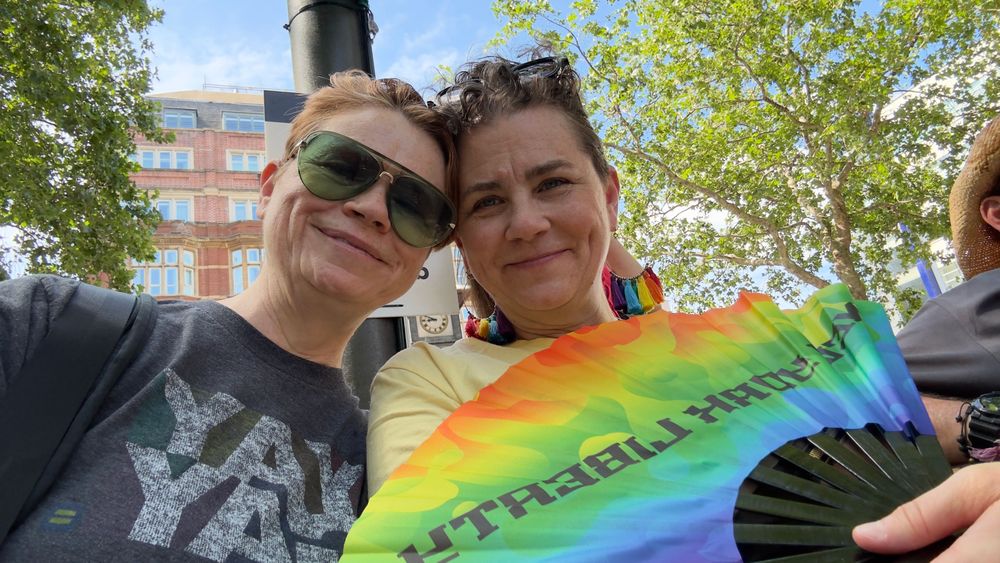
We timed out trip for Pride in London. Credit: Tanya Churchmuch
I’ve been lucky enough to visit the Big Smoke many times over the years, which means I can skip the traditional tourist checklist for the city. No Tower of London, no Westminster Abbey, no Buckingham Palace, though they might well be on your itinerary. I live in New York, and as much as it pains me to say it, I believe London has more to offer queer women. Part of why I keep coming back is how easy London makes it to stumble into lesbian, queer women and FLINTA-focused experiences, often by accident and at low or no cost.
The acronym FLINTA is rarely heard in North America. But it’s become increasingly common in London, especially as a descriptor for clubs and party nights.
Imported from Germany, it stands for female (or women, from the German “frauen”), lesbian, intersex, nonbinary, trans and agender. It’s essentially an umbrella term for anyone who isn’t a cisgender man, centring people who face systemic, patriarchal and gender-based discrimination.
An easy way to unexpectedly stumble across FLINTA offerings is at one of the many museums in London—places that are probably already on a visitor’s list of things to do. Most of London’s major museums have no entry fee and often have permanent collections that specifically incorporate queer artists.
The National Portrait Gallery (St. Martin’s Place, London), the most interesting portrait gallery I’ve visited anywhere, recently had a career retrospective dedicated to Catherine Opie, a queer American artist known for her exploration of Los Angeles lesbian, leather and BDSM communities.
Their permanent collection also highlights lesbian photographers such as Berenice Abbott, a contemporary of Man Ray and Jean Cocteau, and portraits of renowned lesbians including 2012 gold medal boxer Nicola Adams and Mary Sophia Allen, a suffragette and, in the 1920s, founder and commandant of Women Police in London.
(Allen also dabbled in fascism, met Hitler and was called Robert by her close circle of female friends.) The museum even has a helpful list of all pieces with an LGBTQ+ connection.
The British Museum (Great Russell Street, London) offers a weekly queer tour year round, while the main Victoria and Albert Museum (Cromwell Road, London) has a monthly one.
The V&A collection includes several pieces from lesbian feminist art activist collective fierce pussy. In fact, all of the V&A museums across the city, which include V&A East Storehouse (Queen Elizabeth Olympic Park, Parkes St., London) and V&A East Museum (Queen Elizabeth Olympic Park, 107 Carpenters Rd., London), house queer artifacts and make it very easy to access them. The museum that most surprised me was the Museum of the Home (136 Kingsland Rd., London), which revisits British domestic interiors from 1600 to the present.
Though niche, it’s fascinating, and I was amazed to stumble upon an apartment in their permanent collection that highlights lesbian domesticity in a London highrise flat, circa 2005.
It tells the story of a femme-y lesbian couple who took in a soft butch roommate they met at a local queer bar. From the flyers for club nights to a queer bookshelf holding copies of Stone Butch Blues and DIVA magazine, this room is an incredible time capsule.
I spent a good 15 minutes just soaking it all in.
Then there’s the Queer Britain Museum (2 Granary Square, King’s Cross, London), the U.K.’s first and only national museum dedicated exclusively to LGBTQ+ history and culture. Opened in 2022, it’s small in footprint but sprawling in ambition, with four intimate galleries hosting several exhibits at the same time.
When I visited they highlighted the founding and demise of the Black Lesbian and Gay Centre (BLGC), which was organized by a group of Black lesbians in London between 1985 and 2000; an exhibit chronicling the radical feminist and lesbian music movements of the 20th century; a queer print exhibition, including newsletters that lesbian and queer women created in the pre-internet era to safely connect; and a display dedicated to Club Kali, the legendary, long-running London club night established in 1995 to create a safe, celebratory space for the British South Asian LGBTQ+ community.
While I’ve steadfastly refused to visit The Icelandic Phallological Museum (Reykjastræti 4, 101 Reykjavík), aka the Penis Museum, I had no such qualms about visiting London’s Vagina Museum (Arches 275-276, Poyser St., London), the world’s first brick-and-mortar museum dedicated to vulvas, vaginas and the gynae anatomy.
Founded by a queer woman, the description sounds somewhat clinical, but at its core, the Vagina Museum focuses on social justice and public health, expressed through art and storytelling. As a middle-aged woman, the exhibit examining the history and stigma of menopause felt especially powerful. I appreciated the LGBTQ+ inclusion throughout the museum. With just two small floors of exhibition space, a visitor needs only 30 to 40 minutes for a visit.
An exhibit on Club Kali was on show at Queer Britain. Credit: Tanya Churchmuch
You might be surprised: I don’t exclusively plan my trips around lesbian/queer/FLINTA activities and venues. But I usually do research before my departure and create a curated list in Google Maps.
Whenever we’re out and about, I’ll check and see if any of those queer spots are nearby for a visit. I find this especially helpful in huge cities like London where it’s impossible to see and do everything you want to in one trip and you don’t necessarily want to run back and forth between neighbourhoods you’ve already visited.
This is how I was able to stumble upon the English Heritage blue plaque for the Gateways club (239 King’s Rd., Chelsea, London), the legendary bohemian cellar bar that operated as a safe haven and sanctuary for lesbian women from 1931 until it closed in 1985, as well as the historic plaque marking the former home of celebrated lesbian singer Dusty Springfield (38-40 Aubrey Walk, Kensington, London). That said, visitors who are specifically looking for queer women may want to spend more time in East or South London, especially in Hackney, Dalston and Peckham.
In East London, Aya & Suki (62 Broadway Market, London) is a lesbian couple–owned neighbourhood restaurant that was a magnet for queer women when we visited for brunch (they’re also open for dinner and drinks).
Named for the owners’ two children, it’s a colourful sliver of a space, long and narrow, with a coveted window bar seat we wished had been open so we could watch the world go by as we ate. A vegetarian restaurant centred on plant-based Eastern Mediterranean sharing plates, we had a delicious shared meal for two with dips, veggies, poached eggs, flatbread and air-fried halloumi sticks to die for.
Their coffee is even made with beans from the FLINTA-run coffee company We Are Here Coffee, based in the nearby seaside town of Margate. (Read about Tanya Churchmuch’s visit to Margate here.)
About three kilometres away in Hackney, visitors will find Hearth (Unit 30, 86b Wallis Rd., London), a queer women–run, award-winning, sustainable social enterprise bakery.
That description is a mouthful, but the lines out the door are proof they know what they’re doing. With lots of tables for outdoor eating in warm weather, when things get cooler it’s more of a takeaway spot serving artisan wholemeal sourdough and rotating seasonal pastries using 100 percent British organic flour.
We stopped by for a snack on a very hot day and I was rewarded with the most decadent ice cream sandwich of my life: foraged fig leaf ice cream with Kentish cherries, sandwiched between chewy einkorn wheat cookies. Bliss!
Those looking for a more casual fast food–type meal that still supports lesbians should head over to one of several outlets of Bleecker Burger. Owned by former New York City attorney and out lesbian Zan Kaufman, their cheeseburger was twice named the second-best burger in the world—and the best burger in the U.K.—by World’s 101 Best Steak Restaurants. With a menu focusing exclusively on smash burgers, fries and shakes, with locations in Soho, Camden, Seven Dials Market, Spitalfields and elsewhere across the city, Bleeker Burger proudly and publicly supports Black LGBTQIA+ organizations, trans rights groups, medical aid in Palestine and a whole spectrum of other social justice organizations.
One evening my wife and I headed to one of my favourite lesbian spots in London, the sleek and stylish La Camionera (243 Well St., London). A bar-café by day, wine bar by night, the name translates as “female truck driver,” a cheeky nod to Spanish slang for butch lesbians. It’s the primary watering hole for hipster East London lesbians and queers.
When we walked through the door it quickly became clear we’d accidentally stumbled into a very popular lesbian singles’ night. The server clocked that we weren’t looking to meet anybody and suggested we put on a red sticker to show we were taken. Green stickers were for those who wanted to meet somebody, yellow for those open to conversations.
After we grabbed a beer at the front bar, a small table became available in their back patio area, which we quickly nabbed. It was the perfect spot to chat and watch lesbians from their 20s to their 50s, of various styles and cultural backgrounds, go from table to table to introduce themselves and have conversations.
Enjoying a crisp, cold pint at a pub, especially outdoors, is one of my favourite British experiences. There aren’t many of these types of spaces for queers in London quite like the Old Nun’s Head (15 Nunhead Green, London). Local legend says the historic building sits on the site of a nunnery whose Mother Superior was beheaded under Henry VIII. Whether or not that’s true, the pub leans into that legacy, with dark wood panelling and old fireplaces.
It’s a big space, but the night I visited England was playing in the World Cup, and it was packed like queer sardines from the bar to the beer garden. The Old Nun, as locals call it, is one of the rare spots that welcomes a truly mixed queer clientele and hosts loads of FLINTA-focused events. They even give out their pub to anyone fundraising for a cause, free of charge.
Behind the bar sits a Britney shrine, and nearby you’ll spot signs for their ongoing community initiative, the Nun Fund, which raises money to help trans people cover the costs of gender-affirming care and surgery. On my next visit to London, I’ll be back to try their award-winning Sunday roast
Those looking for a big night out of dancing and partying will be impressed with what London has going on.
The main full-time club is She Soho (23A Old Compton St., London), a very popular basement space exclusively for queer women, nonbinary folk and their guests (men can’t get in on their own). Promoters drive much of the scene with myriad party nights—weekly, monthly, annual and otherwise— such as Mint Events, Fèmme Fraîche, g.irlevents, Gal Pals, the Masc Social Club, Meringue Queer Party, Butch Please, Lick, U-Haul Dyke Rescue, Pxssy Palace, Gaytorade and many others.
There’s truly a London club night for every kind of queer female. Those who struggle with making a decision can check out Qrowd.Ldn, Dyke Directory and the London Lesbian Calendar to find out what’s happening during their visit and what might be close.
For our last night in London, my wife and I headed to Dalston for the Roses of Elagabalus (578 Kingsland Rd., London), an intimate, decadent LGBTQ+ clubhouse and cocktail bar that gives nothing away on the street.
From outside it could pass for a dicey late-1990s nightclub. But inside, courtesy of a design team led by the senior interior designer at Soho House, it’s all velvet, mirrors and cabaret rooms.
It’s the kind of place that strictly enforces its no-photos policy: we were given a sticker to put over the camera on our phone. Named for a famously gender-fluid Roman emperor, it draws a very mixed crowd, with lots of queer women there the night we visited.
Our table happened to be right next to the turntable, and before we’d even ordered, we got to chatting with the server as they sorted through which records to play next. They held up two to choose from, one of them Kate Bush’s Never for Ever, an album that’s meant something to my wife and I since our very first date.
That led to us mentioning it was the 15th anniversary of said first date. Of course, the server put on the album, then shared our anniversary news with the chef who came out to congratulate us and ultimately offer us a couple of dishes on the house.
It was all unexpectedly lovely and a reminder that London still had a surprise or two left, even for the most seasoned visitor.
This news has been rearranged and published with the https://www.pinktickettravel.com/
press release subscription.
DEAR MANAGEMENT / PRESS & PR TEAM
Kind Regards,