
















In the months following a period of heightened regional tension, I have spent more time than usual listening to clients, landowners, bankers and operators. The question I am asked most, particularly by family offices in London and Geneva, is a simple one: does the long-term case for the UAE still hold?
By that I mean the proposition that has drawn capital here for two decades: that Dubai is a place where wealth can be preserved and compounded over many years, underpinned by political stability, sound regulation and a government that delivers on what it promises.
My considered answer is that it does, and that the case is stronger now than it has been for some time. I am far from alone in that view.
The institutions that matter are committing with their balance sheets. Brookfield, which manages over a trillion dollars globally, has formed a joint venture with the Alshaya Group to build a 480,000 square foot mixed-use scheme in Dubai Hills.
Blackstone is planning its return to Dubai with a new office in the Dubai International Financial Centre. HSBC, which has been in the country for 80 years this year, has restated the UAE as a priority market for its wealth business. Other global asset managers are pressing ahead with plans for offices in Abu Dhabi.
These are not defensive moves. They are long-term decisions about where global capital will sit over the next twenty years.
The data has caught up with what we see on the ground. The UAE was the world’s leading destination for millionaire migration in 2025, drawing an estimated 9,800 high-net-worth individuals, most of them to Dubai.
Henley and Partners’ 2026 report gives the UAE a wealth mobility competitiveness score of 85.3, among the highest of any jurisdiction it measures, on tax competitiveness, investor access, family inclusion, safety, connectivity and long-term residence pathways.
The same report records a rise in enquiries from UAE-based individuals about alternative residence, and frames the story not as an exodus but as diversification, with internationally mobile families broadening their options around a UAE base rather than leaving it.

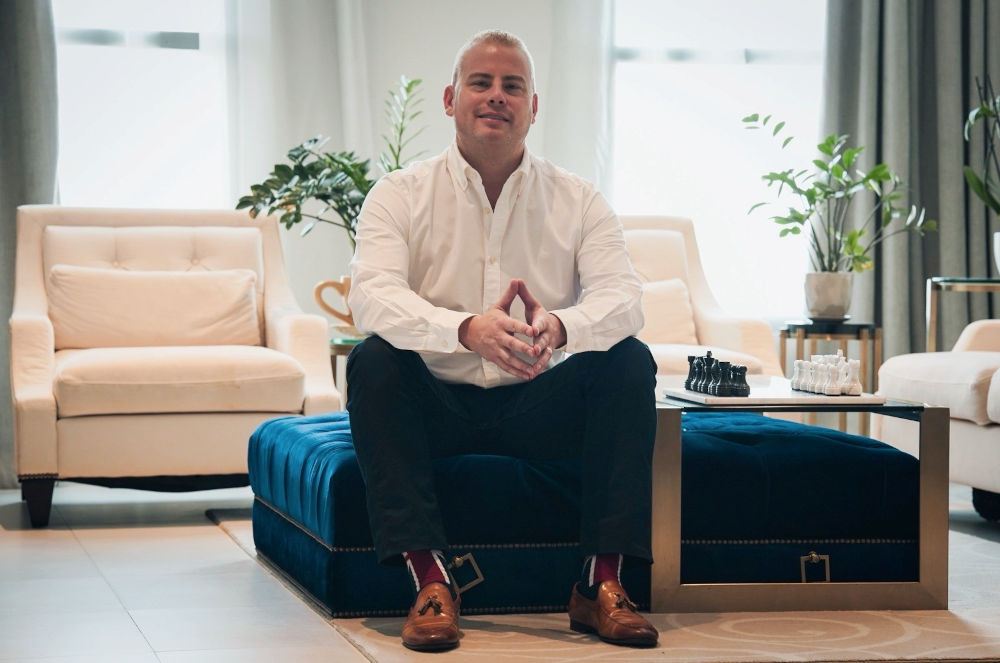
Alex Johnson is the Dubai-based founder and CEO of Alexander Johnson Group, a real estate advisory specialising in commercial land, offices, hotels and luxury residential
The financial centre is still filling up, and the timing of that matters. The Dubai International Financial Centre passed 10,000 active registered companies for the first time in the first half of 2026, reaching 10,018 after attracting 2,318 new registrations, organic growth of 30 per cent in 12 months.
Wealth and asset management firms rose 35 per cent to 592, and family-related entities were up 36 per cent to 1,408. DIFC now ranks seventh globally in the Global Financial Centres Index. That is how investors behave around an asset they regard as core.
Beyond the data, there is a deeper form of stability that matters more than any single metric. It is the orderly transfer of authority.
Recent coverage of Sheikh Khaled bin Mohamed bin Zayed highlights a leader taking on an increasingly visible role across major international deals, diplomacy and strategic decisions, and a generational transition being prepared deliberately rather than left to chance. For anyone allocating capital over decades, leadership predictability is itself a form of capital.
The proof is in the structuring. In January, Abu Dhabi announced that ADQ would come under the control of L’imad Holding, a new sovereign investment vehicle overseen by Crown Prince Sheikh Khaled bin Mohamed bin Zayed.
The same horizon shows up in where the money goes. Mubadala and Aldar have announced a more than 60 billion dirham expansion of Abu Dhabi’s financial district on Al Maryah Island, the physical anchor of the emirate’s ambition to be a global financial centre. Real estate sits underneath all of it.
The emirate is spending into its own future rather than retrenching. Dubai’s 2026 budget is the largest in its history, part of a 302.7 billion dirham three-year programme, with close to half directed at infrastructure, and it is operating from surplus.

The clearest expression is Al Maktoum International Airport, which Sheikh Mohammed bin Rashid calls “our new global airport”. In June, Sheikh Hamdan approved fresh delivery milestones on the roughly 128 billion dirham project, with more than 13 billion dirhams of contracts awarded and over 55 billion dirhams more due by the end of this year, ahead of first-phase completion in 2032.
Airports of that scale are built around a conviction about where people and goods will move for half a century, and every hotel, office and logistics asset in the catchment benefits from it.
When pressure built, the government accelerated rather than paused, introducing billions of dirhams of targeted support across tourism, trade, education and customs. As Sheikh Mohammed has put it, whoever bets on Dubai is betting on the future. For an investor weighing where to place long-duration capital, that is not a slogan. It is a statement of intent from the people writing the budget.
For the right buyer, one of the most overlooked opportunities remains commercial and development land, which in our view continues to trade below the income potential of completed assets.
Dubai closed 2025 with a record result, and the market entered 2026 on a strong footing before being tested by the conflict in March. Even so, values held and the higher-value end of the market remained resilient.
Total real estate transactions in the first half of 2026 reached 419.9 billion dirhams, one of the strongest half-year performances in the market’s history, with property sales delivering the second strongest first half on record. June alone accounted for 32.66 billion dirhams, up more than 30 per cent month on month, with 19 homes sold above 30 million dirhams as the luxury segment led the market.
In Abu Dhabi, transaction activity more than doubled year on year as international investment into the capital reached record levels, with 117 billion dirhams transacted and foreign direct investment of 13.8 billion dirhams, already ahead of the whole of 2025.
What it was not is a turn in the cycle. Values held, the higher-value end of the market led, and the picture is one of a market maturing into balance rather than slowing into weakness.
High-quality office space is genuinely scarce. There is far too little modern stock that the managers and corporates now establishing here actually need, and rents and values are firming as a result. Off-plan office sales in Dubai reached a record 13.1 billion dirhams in six months, more than the sector’s combined sales over the previous seven years.
Grade A rents are up 19 per cent year on year, occupancy is holding at 95 per cent with core districts such as DIFC at or near full capacity, and the roughly 24 million square feet of new supply due by 2030 is heavily pre-committed before completion.
Tourism was the sector most exposed when the conflict peaked: occupancy fell sharply in March as airspace closed and travel advisories went up, and the government moved quickly to support liquidity across the sector.
That trough now appears to have passed. Advisories are easing as conditions improve, the operators we speak to expect a recovery led by the luxury end, and the fourth quarter is gathering pace, with a strong international events calendar and the return of business and conference travel pointing to a rebuild in demand.
For patient capital, a quality asset bought into a recovering market, backed by a government that has shown it will stand behind owners, is exactly the kind of entry point a long horizon rewards.
The same pattern is visible across the market. The clearest trend is appetite for ready, income-producing assets, completed offices, operating hotels and serviced sites that can be bought and held, alongside development land acquired against a defined plan. In the past month alone we have been asked to source plots for developers with funding in place, whole buildings for investors looking to reposition or hold for income, and large family homes for private buyers with confirmed budgets.
The most disciplined buyers, family offices in particular, are working to specific mandates, defined by sector, location and ticket size, and increasingly want the right asset sourced off-market rather than waiting for it to be advertised. There are sellers too, owners who judge this the right point in the cycle to sell into that well-capitalised demand. The market is moving in both directions, and it is moving with quality.
At Alexander Johnson Group, we take a private banking approach: not transactional, but structured to protect capital and compound returns over time.
That discipline now runs from commercial land and offices through to hotels and luxury residential, including off-plan, following the appointment in July of a partner and head of residential to meet growing demand from clients seeking high-end luxury properties. Our team’s combined experience of over 100 years in the region gives clients early sight of opportunities that rarely reach the open market.
The headlines will keep changing. What does not is that the UAE has spent two decades building the regulatory and physical infrastructure, and the institutional credibility, that long-term capital requires before it commits. For serious investors, the question is no longer whether the UAE deserves attention, but whether they can afford to ignore what is being built here. The conversation is now about timing, asset selection and conviction.
Alex Johnson is the Dubai-based Founder and CEO of Alexander Johnson Group, a real estate advisory specialising in commercial land, offices, hotels and luxury residential, including off-plan, across the UAE. The firm operates from Dubai and London.
Sources
Dubai Land Department (H1 2026 transaction data); Abu Dhabi Real Estate Centre (H1 2026); Dubai International Financial Centre (H1 2026 results, July 2026); Henley & Partners Private Wealth Migration Report 2026; JLL, CBRE and Knight Frank (office market, H1 2026); CoStar and operator commentary (hospitality); Government of Dubai and Dubai Aviation Engineering Projects
(budget and Al Maktoum International Airport)