















Twenty years ago, Sofia Coppola’s 2006 film Marie Antoinette was released to a mixed reaction.
Some applauded its unusual nature, while others dismissed it. Critics booed the film at Cannes, calling it a superficial, pastel-coloured confection. However, with a major new exhibition at the Petit Trianon inside the Palace of Versailles, running from 22 September 2026 until 24 January 2027, the film is now receiving the ultimate institutional validation.
Conceived in close collaboration with the filmmaker and curated by Laurent Salomé, director of the National Museum of the Châteaux of Versailles, and Hélène Delalex, the palace’s chief curator of heritage, the show transforms a once-misunderstood project into a celebrated work of art.
As visitors move through the venue, they encounter a dialogue between real history and cinematic illusion, exploring the Trianon estate as the Queen’s personal domain, which Louis XVI gifted to her as a private sanctuary away from the rigid etiquette and intrigue of court.
It showcases original production artefacts, including Milena Canonero’s costumes and accessories, which won an Oscar for Best Costume Design, offering insight into how the film transcends the traditional, restrained boundaries of period dramas.
By emphasising the opulence of the French court, the film also reveals the isolation and performative nature of Marie Antoinette’s life, portraying her existence as a continuous public spectacle.

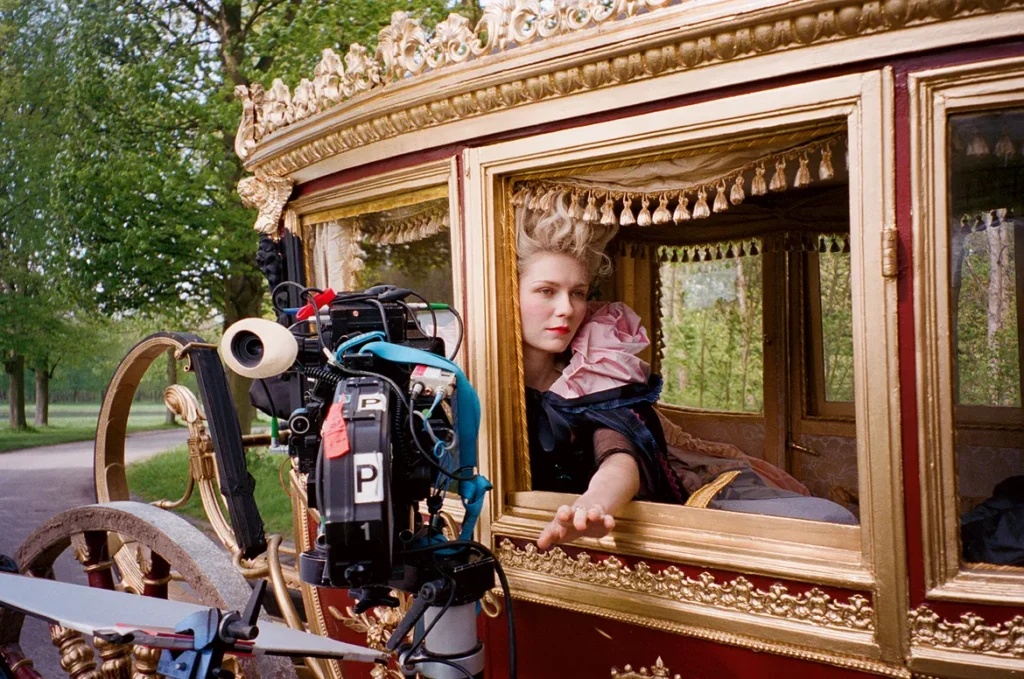
To mark the twentieth anniversary, exhibition sponsor Cartier hosted two screenings through the Cartier Cinema Club, attended by Sofia Coppola, pictured. Coppola also signed the new book by Andrew Durham, Making Marie Antoinette, at the Fondation Cartier pour l’art contemporain.

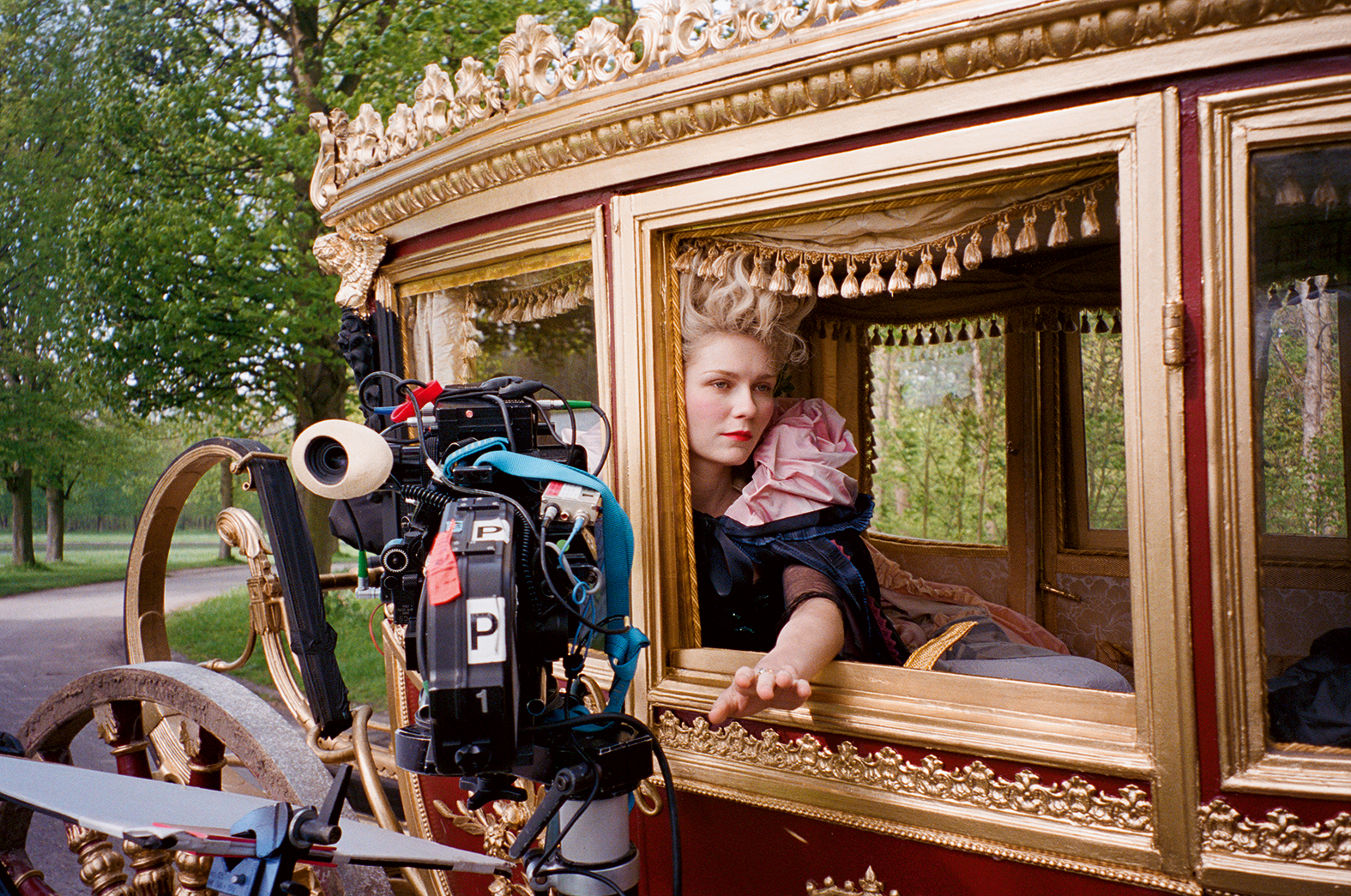
Sofia Coppola on the set of Marie Antoinette
‘I was surprised and excited that the curators wanted to do this exhibit,’ Coppola tells Wallpaper*. ‘It’s a strange, unique feeling to visit elements of the filmmaking in Marie Antoinette’s actual home, to look at our interpretation of her next to her real busts, with the view of her garden, blurring history and recreation in a way I’ve never seen before. I haven’t worked on an exhibit before, and the curators really invited me and let me set it up, which was amazing to do in the place.’
Stepping inside the ground floor of the Petit Trianon, the intimate space evokes a domestic tranquillity. Unlike other French Queens, such as Catherine de Medici, Marie Antoinette’s historical image carries a lightness of spirit, characterised by fashion, courtly entertainments and pastoral escapism, which were criticised during her lifetime. This exhibition highlights this by presenting the space not as a fixed monument but as an active home.

Coppola’s bold aesthetic choices, including decadent visuals paired with a 1980s pop soundtrack, create a juxtaposition between consumerism and historical introspection.
The film reflects not only Marie Antoinette’s evolution from a confined teenager to an independent mother amid societal upheaval, but also explores themes of isolation. ‘I tried to convey the way they lived and Marie Antoinette’s emotional state and bring the audience into their world instead of looking back as a history lesson. To make it feel tangible and immersive, that you’re there with them. I felt that it could be made with the same playfulness as her follies,’ Coppola says.
The retrospective, supported by Cartier, marks a moment of reflection for the institution of Versailles. For Salomé, launching this unique film archive at the palace felt timely, connecting the location’s cinematic legacy with an ambitious curatorial approach.
‘It’s a very unusual exhibition for us because we don’t usually have events like this at the Petit Trianon,’ he explains. ‘This is the first time we have an exhibition on one film and the making of it.‘
Choosing the château was an intentional storytelling decision. ‘A lot of the scenes actually made in Versailles were shot in the main palace, but Petit Trianon is completely related to Marie Antoinette,’ Salomé says, noting that it became her rural refuge from stiff court etiquette. The exhibit pays homage to the artistry of filmmaking.